

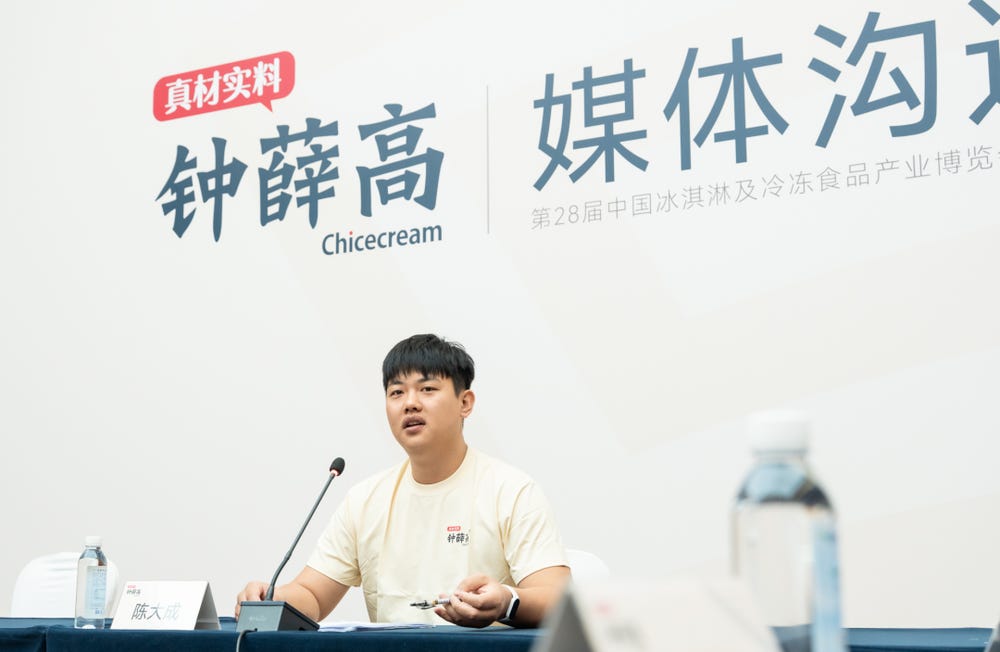
In May 2026, the bankrupt ice cream brand Chicecream (Zhongxuegao;钟薛高) sold its intellectual property — a portfolio of 508 trademarks, patents and copyrights — at a judicial auction for 21.1 million yuan, more than nine times its starting price. The new operating company is 60% owned by an individual, Wang Yaqing, and 40% by Royal Little Tiger's parent company, a frozen food supplier.
Royal Little Tiger is a supply chain company. Its founder, Shi Kaiming, built it to 4 billion yuan in annual retail sales in just five years, with backing from Shunwei Capital, Challenger Ventures and Yili. Its core strength is cold chain logistics: 49 self-operated warehouses plus a network of cloud warehouses, giving it fulfillment costs roughly 50% lower than those of third-party providers.
Undoubtedly, cutting prices is the first move to quell public controversy over its previously excessive pricing issue. Although the products have not yet hit store shelves, the pricing is already set: 6.9 to 7.9 yuan — nearly half the previous 13 to 20 yuan range — Meaning, it sits slightly above mainstream domestic ice cream brands on price, while undercutting some mainstream foreign ones.
Meanwhile, the brand promises the ingredients will remain unchanged. It says factory costs have not changed much and that the savings come from slashing channel markups and the brand premium.
Still, it will not be easy to repair the brand’s battered reputation. Consumer anger has not fully cooled — as seen when, after netizens suspected that Luo Yonghao was comparing Yeah Gelato and Chicecream in order to “promote” Chicecream’s comeback, he was immediately besieged by netizens again, while they also vented their dissatisfaction with Chicecream. Clearly, people’s “painful memories” of and “anger” toward Chicecream have not disappeared at all.
Let’s briefly revisit the painful “ice cream assassin” saga. It boiled down to two issues: food safety, and high prices paired with a condescending attitude.
During the 2022 "Chicecream’s product won't melt under fire" controversy, what unsettled consumers was carrageenan — and the "what exactly am I eating" unease it triggered. Chicecream's response was widely seen as a refusal to bow to consumers as it kept insisting on "consumers don't understand the industry."
What poured fuel on the fire was the founder’s response, during a program discussion of costs and pricing, to claims that its costs were indeed high: he told consumers, in effect, “take it or leave it.” The remark enraged almost all viewers. Although the founder insisted it was malicious editing — and a court has already ruled against the malicious editor — consumers still refuse to let Chicecream off the hook.
Legally, Chicecream did nothing wrong — but consumers have their own set of criteria and standards for judgment, even though those standards may be unreasonable or even deliberately stoked by others.
Royal Little Tiger’s founder said he isn’t sure he can make Chicecream successful again. Good — that may be the most honest voice in the whole saga. At least he understands how hard this is.
But I’m just curious how they claim to have “unchanged ingredients” while resolving the carrageenan issue. My guess is that the formula stays the same on paper, but the proportions and details have almost certainly been tweaked. If so, will the final product — its texture and taste — still be somewhat different?
For now, whether the market feedback on this product will be positive remains a mystery. The new leadership team must be very nervous.
