When the Dark Forest Is Rationalized
Trump, Narrative Fracture, and Western Discourse's Self-Defense

The “Dark Forest Law” proposed by Liu Cixin in The Three-Body Problem was originally a cautionary science fiction metaphor: in a highly uncertain environment, survival becomes the ultimate goal, civilizations cannot trust one another, and preemptive strikes become the rational choice. This concept is philosophically familiar, tracing its intellectual roots to Hobbes’ Leviathan—in the state of nature, security takes precedence over morality, and survival overwhelms all order.
Well — Is the Dark Forest a description of the world’s true nature, or a warning against civilizational failure?
For a long time, the Western-dominated international narrative has consistently sought to prove the latter. Rules, institutions, and values are repeatedly emphasized precisely to demonstrate that humanity has developed the capacity to transcend jungle logic.
However, Trump’s emergence and his recent action is systematically dismantling this narrative effort, forcing the world to confront anew a question it has been unwilling to acknowledge:
Perhaps the Dark Forest never disappeared, but was merely temporarily obscured.
Trump Is Not an Exception, but a Trigger for Making Things Explicit
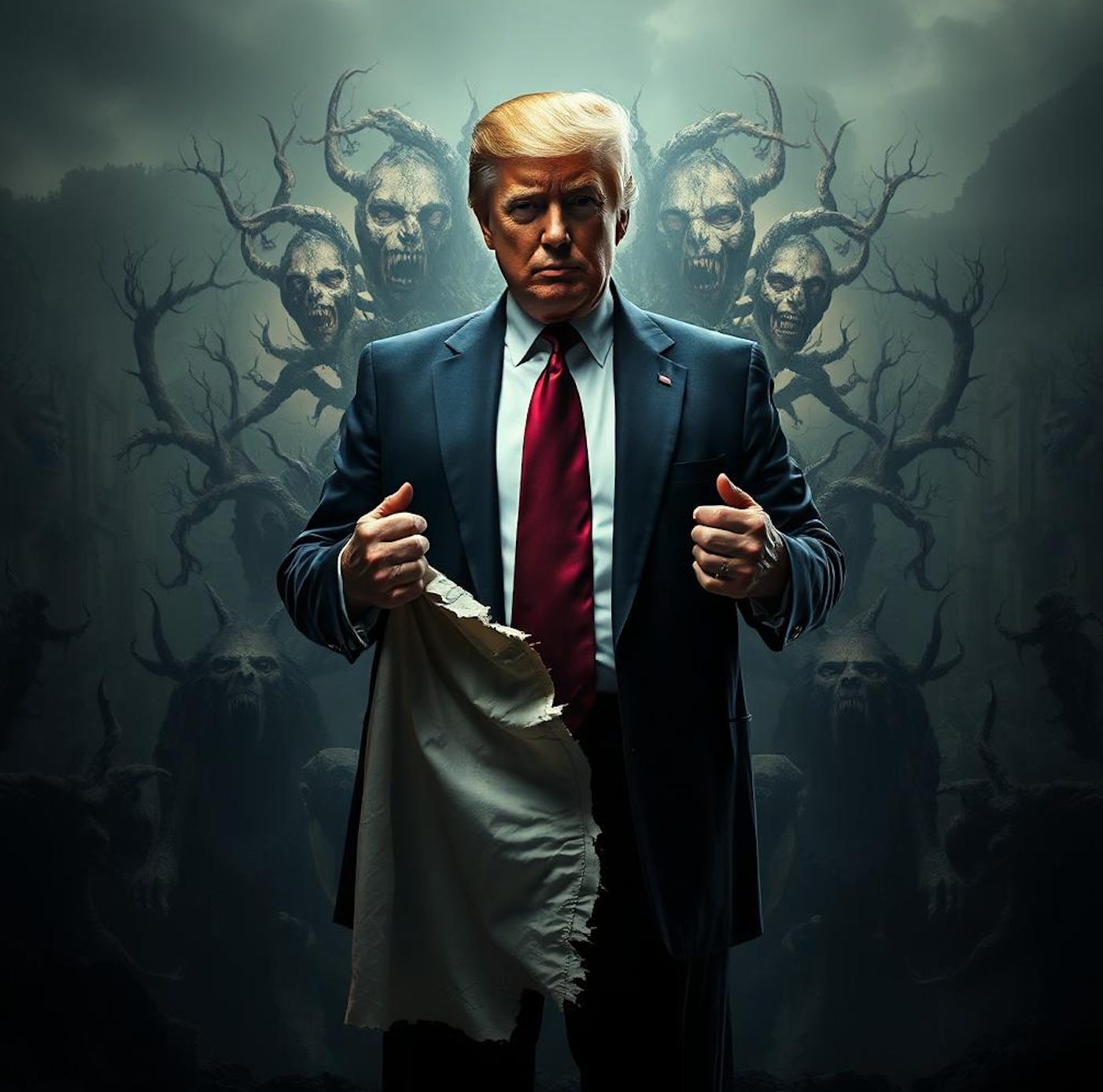
Trump did not “invent” power politics; he merely tore away the packaging.
In his foreign policy and security strategy, values are no longer constraints but disposable decorations; rules are no longer bottom lines but bargaining chips. This naked realism has forced the Western narrative system into a mode of self-repair, rapidly splitting into several seemingly contradictory yet actually complementary explanatory paths.
Three Western Narrative Responses: Fragmented, Yet Not Out of Control
The first narrative attempts to endorse Trump.
Within this framework, the world is described as having entered a “new rules era” where the return of power politics is inevitable, and America is simply the first to “face reality.” Smart, lovely and easy-going. Intervention in Venezuela is portrayed as rescuing a failed state, pressure on allies is packaged as reshaping order, and containment of China is rationalized as strategic necessity. The Dark Forest is no longer a problem but a fact itself.
The second narrative superficially resents Trump but places all responsibility on the individual.
Trump is portrayed as “the destroyer of values,” but the values themselves must be preserved, especially as tools for external competition. Though the logic is inconsistent, it is highly practical: methods may temporarily fall into disorder, but moral discourse must never be abandoned, or the entire system will lose its legitimacy.
The third narrative stands in moral opposition to Trump but stops at rhetoric.
Criticism exists, opposition exists, but there is no institutionalized capacity for checks and balances, ultimately forming only symbolic resistance.
These three narratives conflict on the surface with one another, yet together they accomplish a critical task: ensuring the value system itself is not negated, while simultaneously enjoying the dividends of evil power politics with Trump serving as the designated scapegoat. Much like an organized crime operation, the system thrives on a division of labor: one breaks the legs, the others preach the law, but everyone shares the loot.
Embarrassed — We should all blame Trump—his actions were unexpected, causing a temporary narrative collapse. But it’s okay—I believe Western thinkers, the smartest people in the world, will likely repair these broken stories into something more persuasive soon.
Why These Narratives Inevitably Converge on the China Question
Despite massive internal Western divisions over Trump, there is remarkable consistency on the China question.
The reason is not complicated. China is not merely challenging a particular rule but has in fact raised a more fundamental question: Is there only one legitimate path to modernization? Once this question is taken seriously, Western narratives of moral and historical superiority become difficult to sustain - so, they change the topic.
Therefore, whether defending Trump, scapegoating him, or merely offering verbal opposition, these seemingly disparate narratives ultimately converge on a singular strategic imperative regarding the China question: China must be consistently framed as a 'risk,' a 'threat,' an 'ideological adversary,' an 'exception to the established order,' or simply an 'object requiring strategic constraint.
This is not conspiracy but a structural form of narrative self-preservation.
Complicating Simple Issues
Western recent narratives have another notable characteristic — a tendency to continually complicate directional and structural issues with less effort on the big picture.
Obviously, the core question need to be asked now that is supposed to be —
“Is power politics devoid of morality reshaping or should it reshape the international order?” , “Is it reasonable for those who question other countries’ challenges to the order to begin changing it themselves and establishing a new system that prioritizes their own interests?” Or “ Is United States still representing the value of humanity?”
However, it is quickly dissected by various experts into energy models, oil business, legal details, sanction tools, and game theory simulations. The discussion becomes increasingly specialized and analytical frameworks grow more refined, yet conclusions remain scattered—ultimately yielding almost no conclusion at all.
In this process, readers become entangled in technical details and prisoner’s dilemma-style assumptions, cycling repeatedly through different information echo chambers, gradually losing the ability to judge overall direction. Complexity is no longer used to clarify reality but to dissolve responsibility—when everything is packaged as “rational choice” and “structural constraints,” behavior itself need not undergo moral scrutiny.
The Taiwan Question—A Typical Case of Fragmented Narrative
Let’s be real — without U.S. authorization or acquiescence, would Japan dare to provoke China like this?
Since Japan is brought into the equation, the narrative transforms from ” China-US civilized or value conflict” into a serious “regional states’ fear of an expansionist power.” This better isolates China in public opinion—look, even your Asian neighbors fear you.
Otherwise, Trump would directly face an unanswerable question — if the United States’ occupation of Venezuela is legitimate, then China’s reunification with Taiwan would be all the more reasonable.
Trump knows it well—so I believe this was arranged and well-planned by Trump in advance—before securing the backyard, shift the Taiwan question onto the micro-level contradictions among China, Japan, and Taiwan, further strip away the narrative, regionalize it, and fragment it—until he appears to have nothing to do with it on the surface.
When the Dark Forest Is “Rationalized”
To me — the most dangerous thing is not acknowledging the existence of the Dark Forest, but beginning to defend it. When “striking first” is described as rational, when distrust is regarded as maturity, when morality is downgraded to a tool, humanity is not discovering the truth of the world but seeking justification for civilization’s retreat.
Warning — Trump’s true legacy is not any particular policy but a narrative shift: from “how should we avoid the jungle” to “the jungle is inevitable.” meaning, we are very closed to the World War 3.
To those who still view Trump as a temporary aberration, the window for correction is closing. Trump acts faster than his critics can theorize. If the West waits for a perfect moral argument to counter him, they may find that the ‘Dark Forest’ has already burned down the library. The narrative is shifting, and once the logic of the jungle is fully rationalized, there will be no turning back. The time to challenge this narrative is not after the dust settles, but right now, while the choice between civilization and survival still exists.