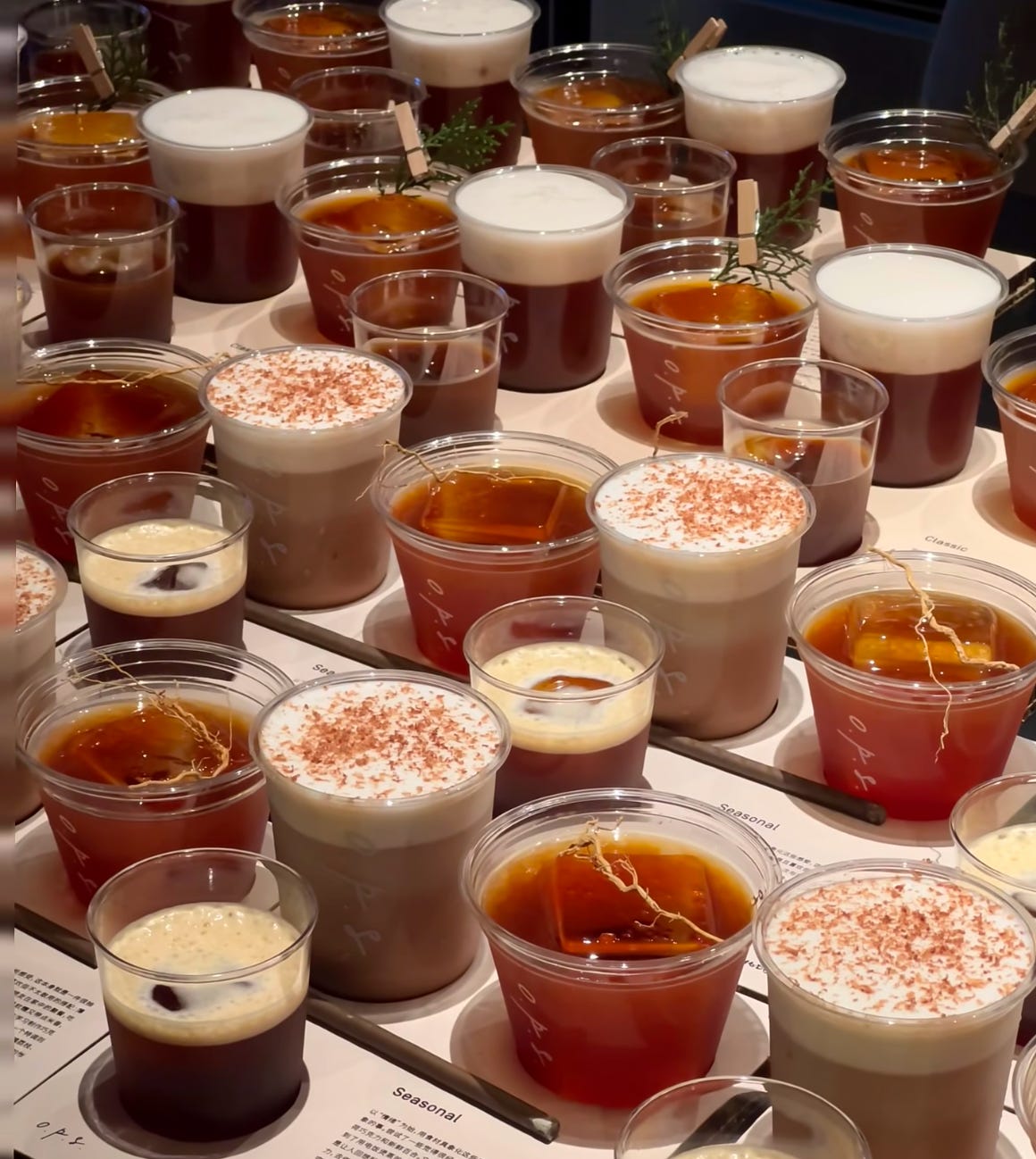
The Myth of China’s Creative Coffee
What's the real role of China's "sugar water" in cafes — often flashy, but with little coffee flavor.
Let me start with a counterintuitive fact: on Xiaohongshu, China’s Instagram, eight or nine out of ten cafés are pushing creative drinks. When foreign media cover China’s coffee scene, they also give these drinks a very prominent place. When you go to a coffee festival in China, you're almost buried under a wave of strange, over-the-top creative concoctions... Mind-blowing, right?
But here’s the reality — for most cafés that plan to stick around, creative coffee just isn’t as hyped as it looks.
Simple logic - If someone is a non-coffee-drinker, coffee is not a necessity. Today they might grab a sweet water from a coffee shop, tomorrow a sweet water from a milk tea shop, the day after that just a Coke. What are the odds they'll drink a creative cup every day in the cafe?
If they are already coffee drinkers, they’ll hardly ever order creative coffee. It’s not the same sensory preference. Once someone is hooked on caffeine, they become acutely sensitive to that vague, gratuitous sweetness. At most, they’ll occasionally try a creative drink with unusual flavors — a very occasional indulgence.
We can acknowledge that creative coffee takes up a higher share in China’s market than in other countries, because it’s a great educational / marketing tool for expanding the consumer base. But aside from a tiny handful of businesses that genuinely rely on it (Luckin among the chains, OPS among the independents; large chains in general surely sell more creative drinks over cafes as they are touching more massive, non-coffee drinkers market) creative coffee’s status is nowhere near as elevated as it appears.
Sure, with so many coffee shops around, the reach of creative coffee is massive. But in terms of depth—its real share of a café's revenue—it's nowhere near as big as it looks. Chinese customers aren't stupid. If you're in a café every day, ignoring a perfectly good coffee to drink sugary nonsense is just a dumb way to kill time.
So when we see: creative coffee's excitement at coffee festivals (probably because it's easy to make, can be sold at high prices, and requires no hauling around of espresso machines), the buzz on social media ( occasionally conspicuous, showy consumption), the prominent placement on café menus ( photos look great, but fresh ingredients need to be used up ASAP) and the weird but eye-catching concoctions in the cup (many of them are silly products with a shelf life of less than a month) … We should keep a cool head about it. Some of them are genuinely good, but none of this changes the fact that creative drinks remain a supporting role in café revenue.
Don’t get me wrong — I have a real spot for these drinks. They’ve expanded our sensory world. The creativity of pulling every kind of ingredient into one cup — it’s adventurous, uncharted, full of imagination. In fact, I’m still paying attention to and looking forward to the continued innovation of this category.
But as a business category, it does not represent the full picture of Chinese coffee. It’s just one corner of a much bigger arena — it shines, but traditional coffee is still the main actor in cafes.


Sam: Nice essay! It brings to mind that excellent Cantonese expression “口水多過茶“.
The gap between what's visible on Xiaohongshu and what's actually driving café revenue is such a good illustration of how misleading Chinese social media can be as a market signal. The creative drink gets the photo, the americano pays the rent.
This also maps onto a broader pattern where foreign brands read the surface of Chinese consumer culture and build strategy around the exception, rather than the rule.