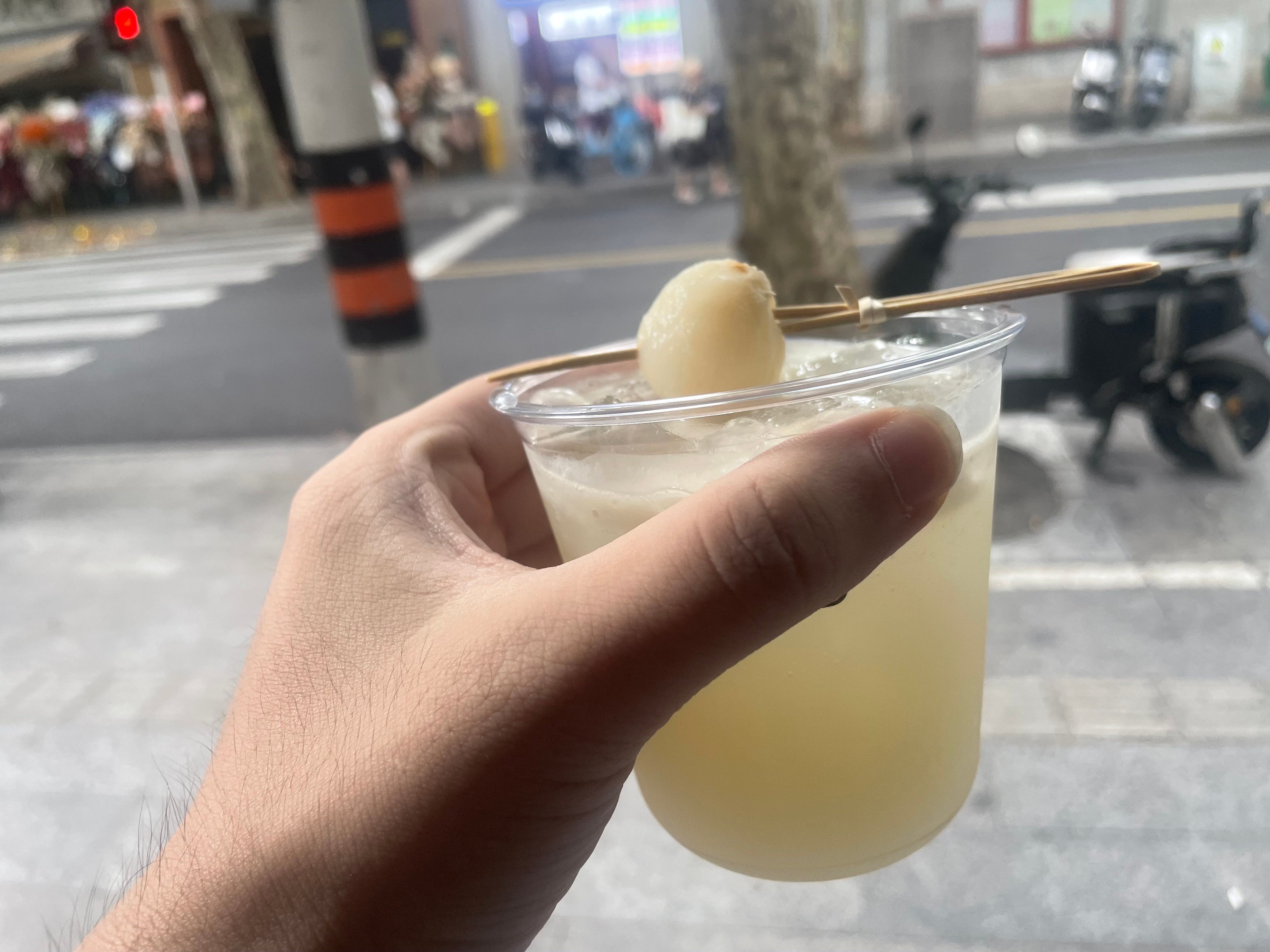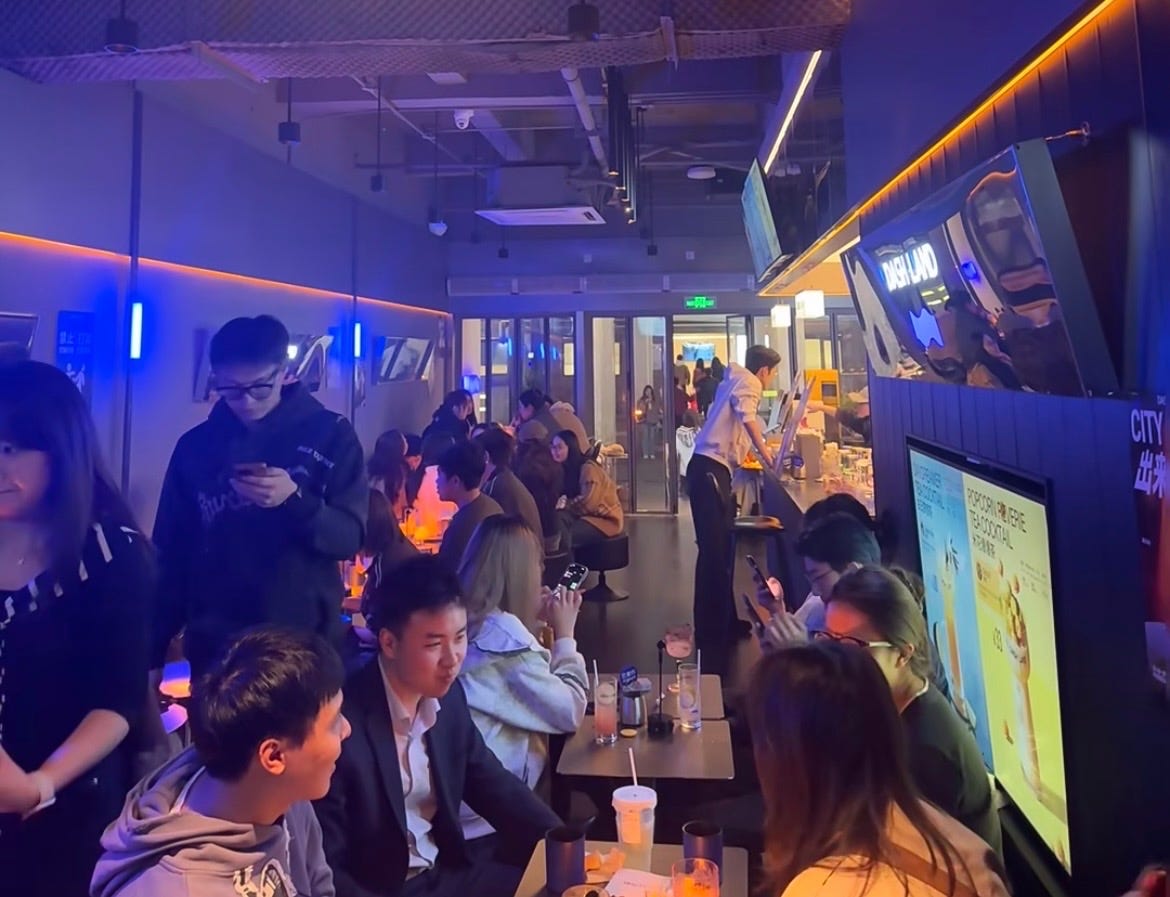
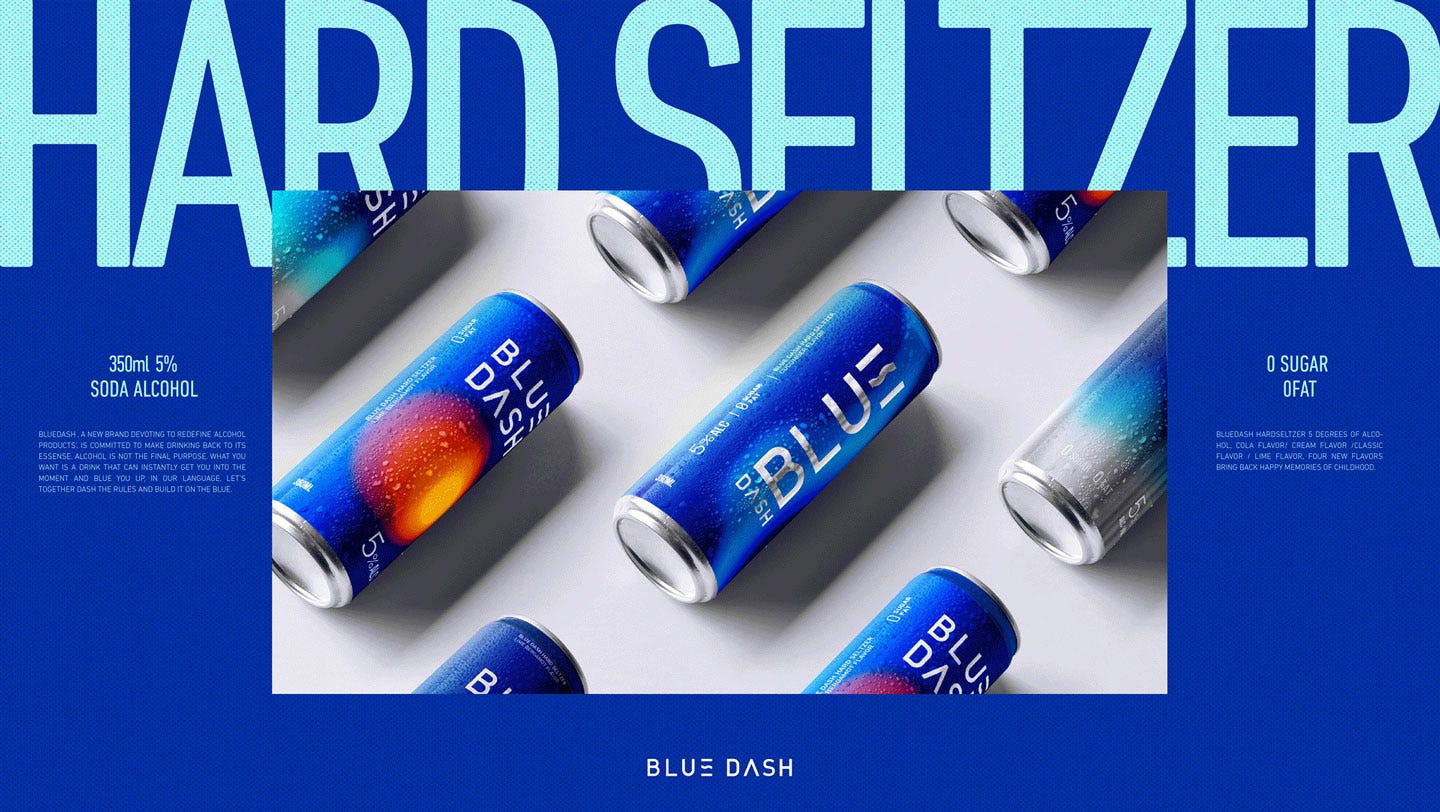
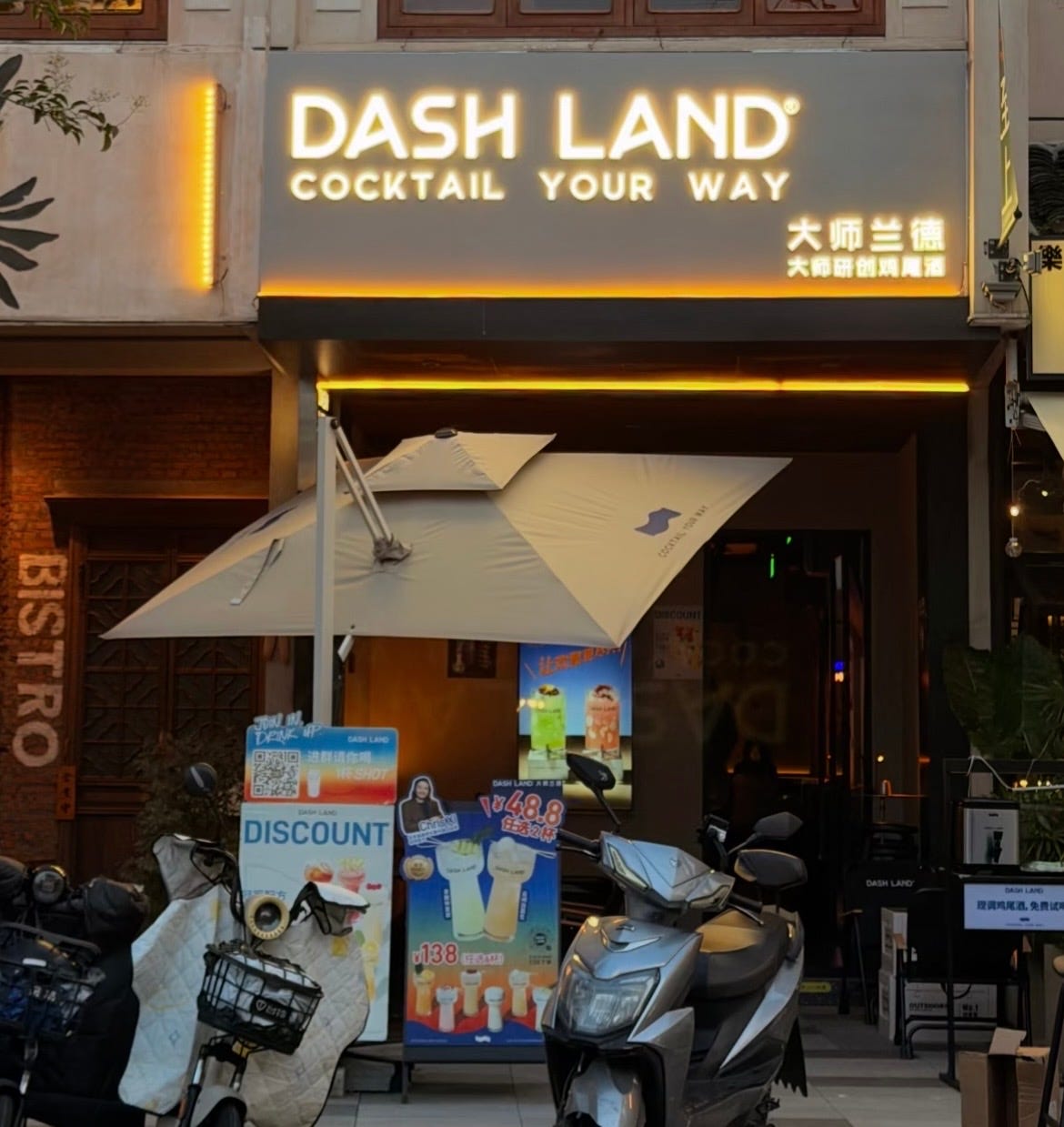
DASH LAND 大师兰德 was born in 2024, founded by Wang Pudi—the same entrepreneur who, back in 2020, founded BLUE DASH, a "de-alcoholized" low-proof spirit brand that took China's nightclub channels by storm.
But Wang saw the ground shifting beneath the industry.
Young people were no longer willing to pay for the inflated premiums of traditional nightclubs — right now, a common cocktail costs at least 100 yuan + / cup in Shanghai while 60 + in small cities — They wanted something lighter, cheaper, and closer to daily life.
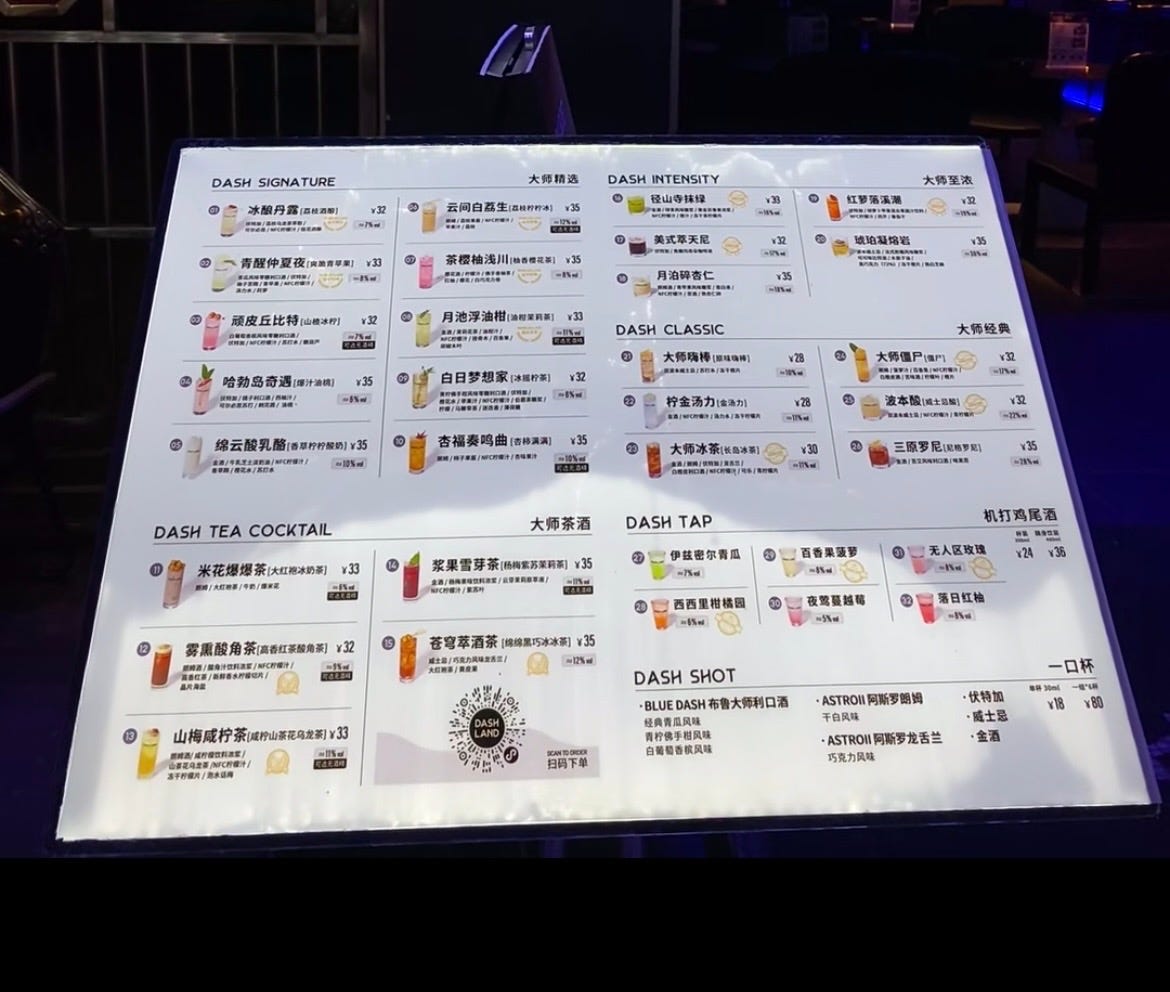
Wang recognized a gap in demand: there are not enough chilled venues for getting tipsy, especially with a more accessible price. So he created DASH LAND — the place to sell cocktails at around 30 rmb — just like selling milk tea —to turn alcohol from a "expensive indulgence" into an "everyday grab-and-go drink." 👇
The Angle — Borrowing the Language of Milk Tea
Walk into any traditional cocktail bar and the menu reads like a password: Martini, Negroni, Old Fashioned, Sazerac. When it comes to cocktails, it gets even more complicated and abstract.
For most young consumers, these names are not easy to understand. They hesitate. They ask the bartender for a "recommendation."
Good interaction — but for a brand that's supposed to scale, this seems entirely unnecessary.
DASH LAND just throws that menu away.

Flavor notes here are translated directly into universally understood descriptions: "sweet and sour," "fruity," "tea-scented." — just like shopping in a milk tea or coffee store.
Also, it takes familiar and trendy milk tea formulas—lychee, guava, Thai milk tea—and uses them as the core structural foundation and the name for its cocktails, so customers can imagine the taste the moment they read the menu, and it is generally all tasted good as the formula has already been tested by milk tea brands.
Wang Pudi:
Young people drink cocktails not because they understand spirits, but cuz the traditional alcohol is too harsh and too bitter. What they want is a tasty, easy-to-drink beverage with alcohol. So we borrow the logic of tea drinks. The tea-drink industry is far more competitive than us—it has already validated many flavors for us. When Thai milk tea goes viral, we make an alcoholic version of it; when guava goes viral, we make a guava flavor. In short, our R&D logic is to never blindly innovate—prioritize reinventing classics, and turn flavors that have already been market-validated into alcoholic drinks.
It doesn't just solve flavor adaptation—it lowers the barrier to drinking alcohol. Consumers don't need to convince themselves, "Tonight I'm having a serious drink to get drunk “ They just say, "I want something sweet, even with a tea note, to enjoy the tipsy”
Non-Standard Backend, Standardized Frontend
The biggest bottleneck in traditional bars' scale is the bartender and space cost.
Bartenders generally cost high salary, high turnover, and product quality depends entirely on experience. Store expansion relies heavily on "masters" training apprentices. That model simply does not multiply.
DASH LAND applies the Luckin model. The underlying logic of the two has similarities:
1) products are highly standardized; R&D and innovation power sits entirely at headquarters. Stores are just execution terminals with fixed process and formulas — no professional skills needed.
2) second, tiny space — 40–80 square meters - fit more location scenarios.
3)then — drive the supply chain cost down through scale.
4)rely on a digital membership system to lift repurchase rates — analyze consume behaviors smartly to empower the innovation back then.
This is exactly the same as when Luckin went after Starbucks back in the day—it's equivalent to me going after traditional cocktail bars now; the logic is identical.
According to Wang,
We are more Luckin-style…A store may only have two or three people, but those two or three people are not necessarily bartenders. They don't need to know how to mix drinks; they could just be a recent college graduate.
This model solves the most difficult problem in chain expansion—extreme light store level operations—with all core competence embedded in the central organization. But the trade-off is clear: the ritual of "handcrafted on site" is sacrificed in exchange for cost control, easy-to-access and rapid replicability.
Expansion is already underway. The brand currently operates 30 stores, but plans to open 1,000 within three years.
The Challenge
Low prices get people through the door once. The real question is: do they come back?
Clearly, the frequency of bar visits is inherently lower than that of milk tea consumption. So -the core challenge is—before consumers habits are fully formed, whether DASH LAND has the patience to educate the market like Luckin did, and stay the course on the product and even overall- experience competition until it succeeds.
Regardless, the attempt to transform cocktails from a "high-priced, low-frequency and a complex" bar experience into an "affordable, convenient and delicious” daily beverage is already a notable progress and innovation —Such an easy and low-stakes option — who could resist?