
Champion Inflation
The Surplus of “Gold Medals” in China‘s Coffee Industry

If you have ever been to a coffee festival in China, you might notice something peculiar: the density of “champions” among the booths is striking. Almost every booth claims to offer “champion‘s brew.” The word “champion” appears on posters, business cards, and coffee bags — basically, it’s everywhere..It is an exaggeration, but not entirely untrue, to say that there seem to be more champions than visitors.
On top of that, many cafés also like to display their competition credentials in prominent places—regardless of the level of the competition or the ranking achieved—simply to project an image of expertise and authority to customers.
One customer took a photo of a café‘s wall of certificates. As you can see, with so many awards on display, she couldn’t help but ask: “How credible are all these titles, really!?” 👇
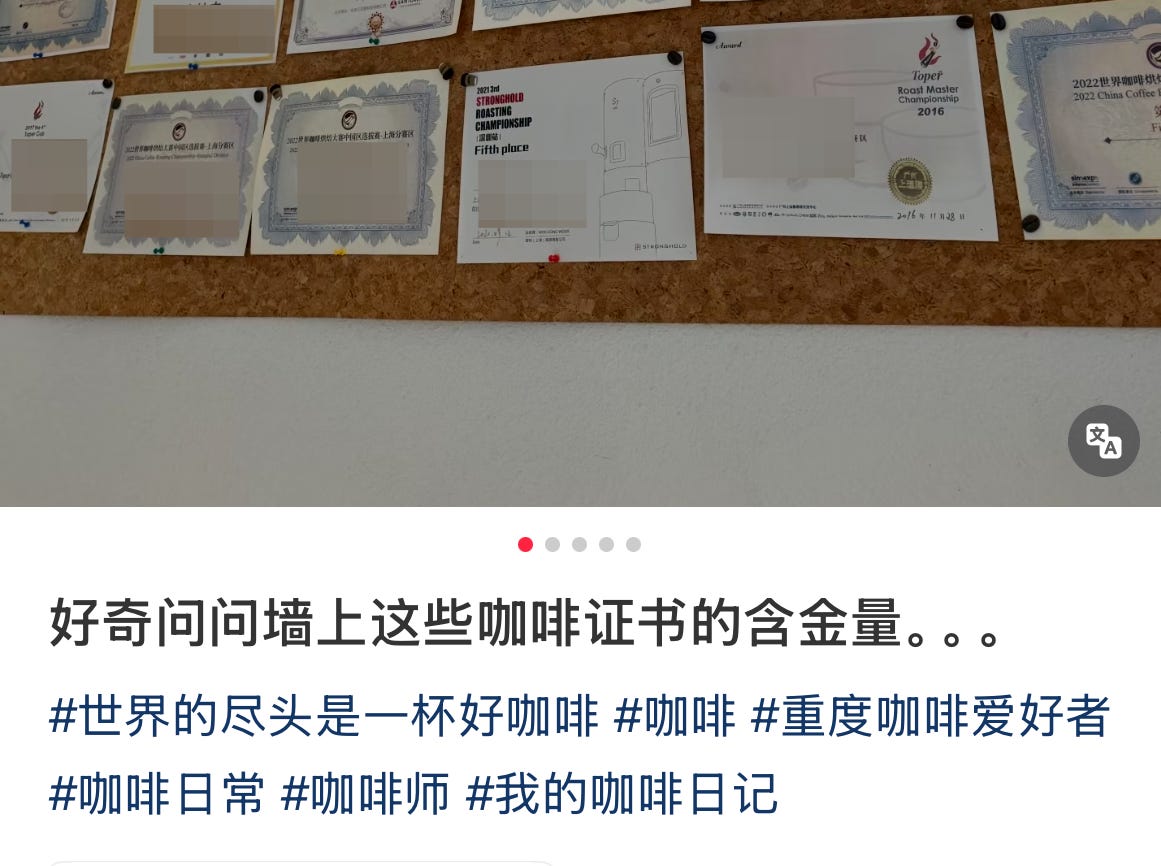
Where are those champions come from? 👇.
Champions, of course, can only emerge from competitions that have the authority to award such titles. So let’s count only domestic, people‑focused coffee competitions (as opposed to bean‑oriented events like IIAC or CoE). The annual output of “champions” is roughly as follows:
- ABrC Amateur Hand-Drip Competition: covers 138 cities – about 1xx city-level champions
- PCA Professional Coffee Masters Competition: 30 stops, three categories – about 9x champions
- TBC King Coffee Challenge: 15 stops, four categories – about 6x champions
- CCL Brewing + CCT Cupping: about 50 stops – roughly 1xx champions
- EBC, ACU, ACRC, CTI, KBC, and other miscellaneous events: about 1xx champions
- SCA series event ~six events ~ nearly 30 regional qualifiers across more than 20 cities and regions annually, generating approximately 30 regional champions per year (one per regional qualifier), plus national final champions for each of the six events—roughly 3x local champions annually.
- brand-run events (e.g., Origami / Stronghold Roasting / HB Championship): xx champions
That adds up to roughly hundreds of “champions” per year - seriously, it’s not a joke…
OFC, there are probably even more table tennis competitions here — Neighborhoods, schools, and workplaces hold countless matches every year. That’s true. Table tennis has hundreds of millions of participants, and the sheer number of grassroots events is enormous—the total count of champions is likely no less than that of coffee.
But here‘s the key difference: you don’t feel them. A community table tennis champion‘s title stays at the venue. Its reach is limited. A coffee competition champion, by contrast, appears on festival posters, on menus advertising “champion‘s brew,” and on coffee bags. Coffee is a retail business. On top of festivals, the champion title is embedded in everyday consumer experience, facing every customer directly.
This is the phenomenon we discuss in this article—“champion inflation” in China‘s coffee industry.
Importantly, SCA events are the real deal in terms of quality and recognition. The “champion inflation” we observe is mostly about the enormous number of locally run competitions, not about diluting the value of SCA titles.
Why are there so many local competitions?
First - organizing competitions is a viable business. The model is straightforward—registration fees, brand sponsorships, venue partnerships—but China’s market scale has amplified its returns. A regional stop costs relatively little to run, yet generates multiple revenue streams.
More importantly, competition influence translates directly into foot traffic and brand premium. Yet the most significant value of winning a champion title may not be industry recognition per se, but rather the way it impresses outside audiences—consumers who have no way to judge technical skill but can read a certificate. Where those certificates came from matters less than the authority they project. And that projected authority, in turn, generates commercial value that often exceeds expectations. The title is not just a medal; it’s a storefront asset.
Remarkably, coffee equipment or farm brands also shine in these competitions. Recognition from top-tier events effectively grants a brand an indisputable badge of trust.
This short link—from event to café / beans / retail to consumer—gives organizers, sponsors, and contestants strong incentives to push into as many cities as possible.
As China’s coffee market continues to expand, more practitioners have entered the industry. More practitioners have led to more competitions. More competitions have attracted more participants. And with more participants chasing titles across ever more events, the explosion of champions becomes hardly surprising.
Two Sides of the Coin
The upside:
The proliferation of competitions has objectively raised the overall skill level of China’s coffee industry. The competition ladder offers a clear pathway: from the café counter to regional stops, from regional to national. Competition-driven learning is more efficient than on-the-job experience alone. To reach any podium, a contestant must invest thousands of hours of practice—and that practice ultimately shows up behind the bar and in the cup. The professional standard of specialty cafés in first- and second-tier cities is now considerable. Turning the café into a competition stage” has become a typical operational trend in China’s coffee shop industry.
The downside:
With over xxx “champions” produced every year, the title itself is diluted. Consumers face a stack of titles with no way to distinguish international from city-level. When supply of “champion” titles far exceeds consumer demand for differentiation, as time goes, the perceived value is inevitably questioned.
More critically, competition skills and café skills are two different toolkits. The former tests peak performance under controlled conditions—fixed beans, fixed equipment, fixed timing. The latter tests consistent delivery under daily realities—unpredictable customers, changing bean conditions, noisy environments, and physical endurance. They overlap, but they are not the same. The premium on “champion‘s brew” does not always translate into a substantially better cup.